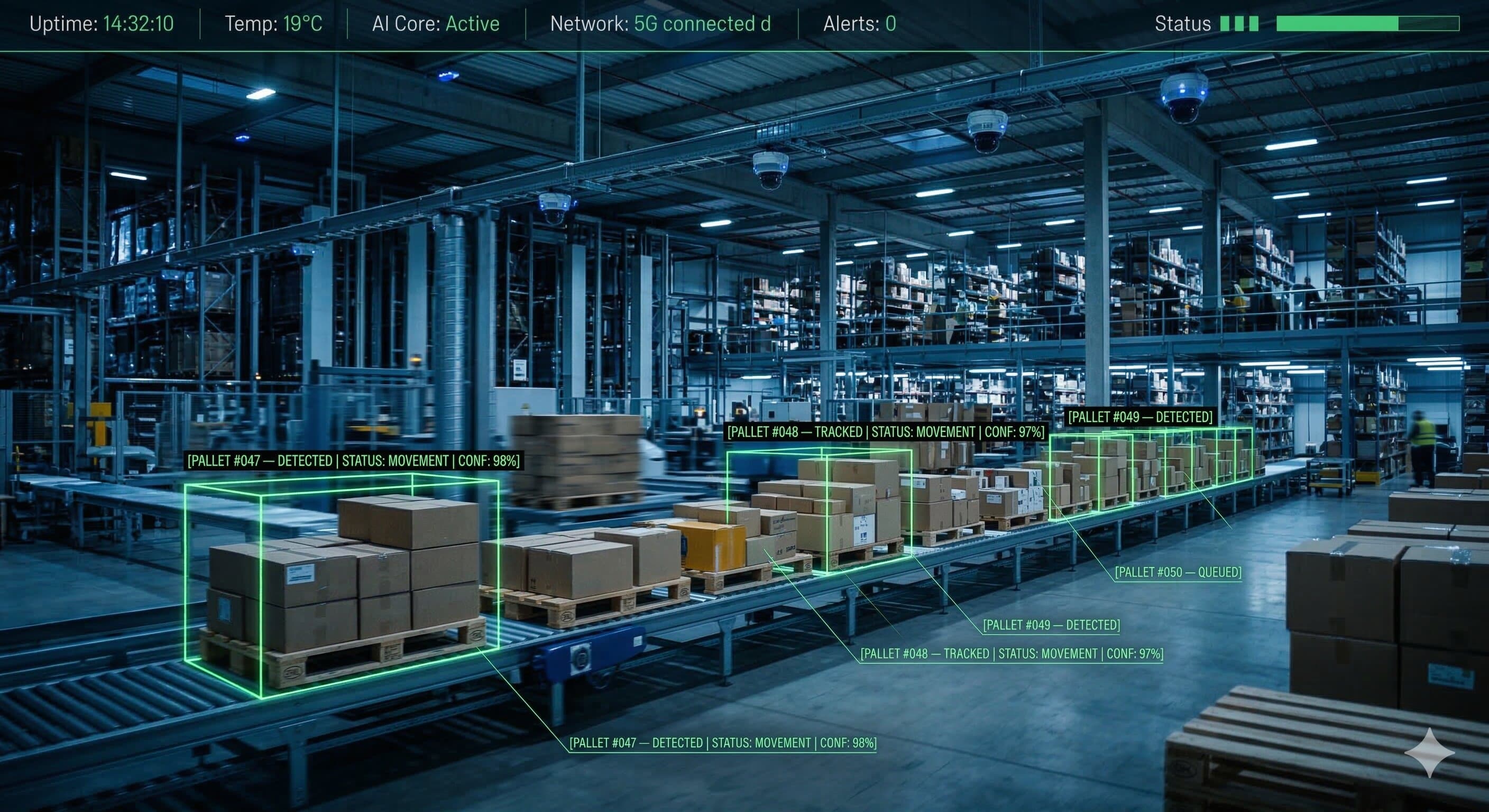
The pallet industry has relied on manual counting for decades. Clipboard tallies, shift-end reports, and spreadsheet reconciliation have been the standard, and everyone in the industry knows the problems: missed counts, delayed reporting, and no real-time visibility into what is happening on the production floor.
That is changing. AI computer vision is now mature enough, affordable enough, and reliable enough to replace manual counting in pallet operations. Here is how it works and why it matters.
The Problem With Manual Pallet Counting
Manual counting creates a cascade of operational issues:
- Inaccuracy: Human counters miss 5-10% of events, especially during high-volume shifts or when fatigued
- Delays: Production data is not available until shift-end reports are compiled, often the next morning
- Labor cost: Dedicated counters or supervisors spending hours on verification could be doing higher-value work
- No real-time visibility: Managers cannot see what is happening on the floor without walking it
These are not theoretical problems. They are the daily reality for hundreds of pallet operations across the country.
How AI Computer Vision Works for Pallets
AI computer vision for pallet tracking follows a straightforward process:
- Cameras capture video of production stations (build lines, repair stations, dismantling areas, trim saws)
- Edge AI models process the video in real time, detecting pallet and board events as they happen
- Events are classified and counted with timestamps, zone information, and confidence scores
- Data flows to dashboards and ERP systems automatically, giving everyone from floor operators to plant managers instant access to production metrics
The key innovation is not the camera, it is the AI model. Purpose-built models trained specifically on pallet operations can distinguish between a finished pallet, a work-in-progress repair, and a stack of dismantled boards in conditions that would confuse a general-purpose system.
Why Physical AI Matters for Pallet Operations
Physical AI, AI that operates in the real, tangible world, is different from the AI you hear about in the news. It is not generating images or writing text. It is watching a nailing machine and counting every pallet that comes off the line.
This distinction matters because physical AI has to deal with challenges that purely digital AI does not face:
- Variable lighting from dawn to dusk and across seasons
- Dust, debris, and visual noise common in lumber operations
- Occlusions from stacked pallets, passing forklifts, and operator movement
- Speed of production lines that require real-time processing
Systems built for pallet operations, like PalletVision, address these challenges through purpose-built models trained on thousands of hours of real production footage.
The Impact on Production Metrics
When you replace manual counting with AI, the impact is immediate and measurable:
- Accuracy jumps dramatically compared to manual counting baselines
- Data is available in real time, not the next morning
- Labor effort drops by 40% as counting and verification tasks are eliminated
- ERP data is always current because production counts sync automatically
These are not hypothetical numbers. They are what operations see within the first weeks of deployment.
Getting Started Is Simpler Than You Think
The most common objection we hear is: "This sounds like a massive IT project." It is not. AI pallet tracking works with the cameras most operations already have installed for security. The AI processing happens on edge hardware installed on-site, no cloud dependency, no bandwidth concerns.
A typical deployment:
- Connect existing cameras or install purpose-built camera kits
- Configure production zones and AI scenarios
- Integrate with your ERP (PalletConnect or flat-file export)
- Start seeing real-time production data on dashboards
Most operations are fully deployed in days, not months.
What Comes Next
AI computer vision for pallet operations is not a future technology. It is deployed today, processing thousands of production events daily at industry-leading pallet companies. As models improve and edge hardware gets more capable, the accuracy and breadth of what can be tracked will only increase.
The question for pallet companies is not whether to adopt AI tracking, but how soon they can start benefiting from it.