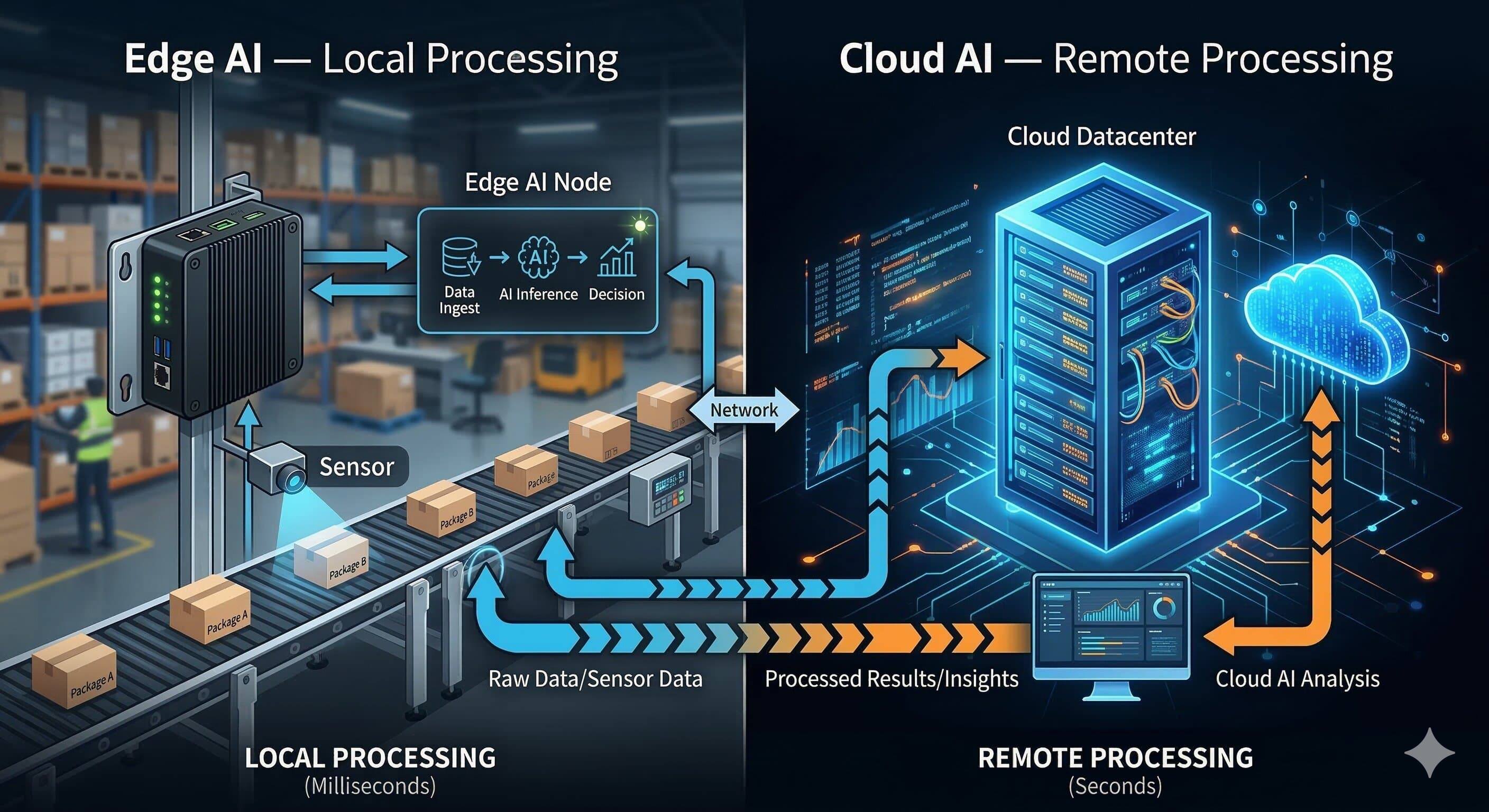
When evaluating AI for pallet production tracking, one of the most important architectural decisions is where the AI processing happens. The two main approaches, edge AI (on-premise) and cloud AI, have fundamentally different characteristics that impact reliability, speed, cost, and security.
For pallet operations, the choice is clear. Here is why.
What Edge AI Means for Pallet Tracking
Edge AI runs AI models on hardware installed at your facility. Camera video streams are processed locally, on a device sitting in your server room or on the production floor. Detection, classification, and counting happen in real time without any data leaving your network for processing.
In practice, this means:
- Camera feeds never leave your building for AI processing
- Counting results are available in milliseconds, not seconds
- The system works even if your internet goes down
- There are no per-frame cloud processing costs
What Cloud AI Means for Pallet Tracking
Cloud AI sends camera video streams to remote servers (AWS, Azure, GCP) for processing. AI models run in a data center, and results are sent back to your facility.
This approach has trade-offs:
- Bandwidth: Streaming 4-12 camera feeds to the cloud requires significant upload bandwidth
- Latency: Round-trip processing adds seconds of delay to every detection event
- Reliability: If your internet goes down, tracking stops entirely
- Cost: Cloud GPU processing is priced per compute-hour, and video is expensive to process
Why Edge AI Wins for Pallet Operations
1. Latency and Real-Time Performance
Pallet production lines move fast. A nailing machine can produce a pallet every 30-60 seconds. Repair stations process units continuously. Trim saws cut boards in rapid succession.
For accurate counting, the AI must process every frame without delay. Edge AI delivers sub-second processing because there is no network round-trip. Cloud AI introduces variable latency that can cause missed events during high-throughput periods.
2. Reliability in Industrial Environments
Pallet facilities are not tech campuses. Internet connectivity can be inconsistent, and downtime is common in rural and industrial areas. When the internet drops:
- Edge AI: Continues processing. All counts and events are logged locally and synced when connectivity returns.
- Cloud AI: Stops entirely. Every minute of downtime is lost production data that cannot be recovered.
For operations that run 16-24 hours per day, even occasional outages create unacceptable gaps in production data.
3. Bandwidth and Network Cost
A single camera stream at production quality uses 2-8 Mbps. An 8-camera deployment requires 16-64 Mbps of sustained upload bandwidth for cloud processing. For many pallet facilities, this exceeds available bandwidth and requires expensive network upgrades.
Edge AI has zero bandwidth requirements for processing. The only network traffic is lightweight data: count events, timestamps, and dashboard updates. This is a fraction of a percent of what cloud streaming requires.
4. Data Security and Control
Pallet operations are competitive businesses. Production volumes, customer orders, and operational efficiency data are sensitive. Edge AI keeps all video and production data on your premises. Nothing leaves your network unless you choose to share it.
Cloud AI requires sending continuous video streams to third-party infrastructure, raising questions about data residency, access control, and competitive intelligence.
5. Predictable Costs
Cloud AI pricing is typically usage-based: per frame processed, per hour of compute, or per camera stream. For always-on production tracking (16-24 hours daily, 5-7 days per week), these costs add up quickly and can be unpredictable.
Edge AI has a fixed cost: the hardware. Once installed, there are no per-use fees. The ongoing cost is electricity and occasional model updates, both of which are minimal and predictable.
The Edge AI Setup for Pallet Tracking
A typical PalletVision edge deployment includes:
- Edge AI server: A compact device (Mac mini M4 or dedicated AI server) that runs AI models locally
- Camera connections: Direct RTSP streams from existing or new cameras
- Network connection: Standard Ethernet for dashboard and ERP data sync
- Power: Standard outlet, no special electrical requirements
The entire setup fits in a standard network closet or server shelf. There is no rack space, no cooling requirements beyond normal room temperature, and no specialized IT infrastructure.
When Cloud AI Makes Sense
Cloud AI is not wrong for every use case. It works well for:
- One-time analysis of historical video footage
- Model training and development (which PalletVision handles behind the scenes)
- Dashboard hosting and data aggregation across multiple sites
PalletVision uses a hybrid approach: edge AI for real-time processing and cloud infrastructure for dashboards, model updates, and multi-site analytics. This gives you the best of both worlds: local reliability with cloud convenience.
The Bottom Line
For pallet operations that need reliable, real-time production tracking, edge AI is the right architecture. It eliminates dependency on internet connectivity, removes bandwidth constraints, keeps costs predictable, and ensures your production data stays under your control.
The technology is mature, the hardware is affordable, and the deployment process is straightforward. If you are evaluating AI tracking for your pallet operation, talk to our team about the right edge setup for your facility.